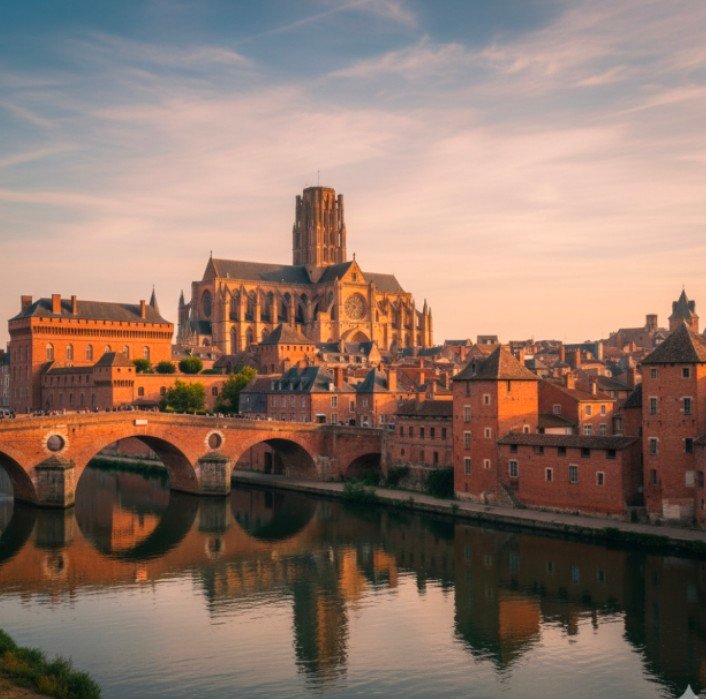
Perched above the Tarn River in southern France, Albi is instantly recognizable by its warm red‑brick skyline. Unlike the stone‑built towns of northern France, Albi radiates a different kind of charm bold, colorful, and deeply southern. Its cathedral towers, medieval streets, and relaxed atmosphere make it one of the most distinctive towns in Occitanie.
From Romans to Cathars
Albi’s story stretches back over two thousand years. First a Roman settlement, it later became a powerful religious center in the Middle Ages. The town is closely tied to the Cathar movement, a Christian sect condemned as heretical. In response, the Catholic Church built the Sainte‑Cécile Cathedral not just a place of worship, but a fortress of authority. Later, Albi prospered through trade, especially thanks to the woad plant, whose blue dye brought wealth and shaped the town’s grand architecture.
Sainte‑Cécile Cathedral: Strength and Splendor
The cathedral is Albi’s beating heart and one of France’s most extraordinary landmarks:
Built entirely of red brick, towering over the town.
A fortress‑like exterior with massive walls.
A lavish interior filled with frescoes, painted ceilings, and intricate sculptures.
One of the largest brick buildings in the world.
The contrast between its austere outside and richly decorated inside is breathtaking. Recognized as a UNESCO World Heritage Site, it embodies both power and artistry.
The Episcopal City and Old Town
Albi’s historic center, known as the Episcopal City, is compact and perfect for walking. Here you’ll find:
Narrow medieval streets lined with red‑brick houses.
Mansions and quiet courtyards.
Stone bridges crossing the Tarn River.
The Pont Vieux, an ancient bridge still in use, offering postcard‑worthy views of the cathedral and riverbanks.
Toulouse‑Lautrec’s Artistic Legacy
Albi is also the birthplace of Henri de Toulouse‑Lautrec, the famous post‑impressionist painter. The Toulouse‑Lautrec Museum, housed in the former bishop’s palace, holds the world’s largest collection of his works. This artistic heritage adds a modern cultural layer to the town’s medieval soul.
Life by the Tarn
Albi moves at the rhythm of southern France. Locals linger over long meals, shop at weekly markets, and stroll along the river. Outdoor cafés and shaded squares invite you to slow down and savor the moment. The Tarn River itself is part of daily life, offering scenic walks and peaceful views.
Flavors of the Southwest
Albi’s cuisine is hearty and full of character:
Cassoulet and slow‑cooked meat dishes.
Duck specialties, cheeses, and rustic breads.
Regional wines from nearby Gaillac vineyards.
Meals are often shared outdoors, in a warm and welcoming atmosphere that reflects the town’s southern spirit

💬 Comments
No comments yet.